
Reducing Bloodstream Infection in Babies Born Under 32 Weeks of Gestation: From Outlier to Outstanding
This 2026 quality improvement project aimed to reduce the incidence of bloodstream infection to a level below the NNAP neonatal unit average and then sustain improvements
Authors
Dr Anshuman Paria, Consultant Neonatologist and Infection Control Lead; Dr Amitava Sur, Consultant Neonatologist; Dr Rajasri Seethamraju, Clinical Director and Consultant Neonatologist; Shameema Reidy (Band 7 NICU IPC lead nurse), Lancashire Women and Newborn Centre, Burnley General Hospital, East Lancashire Hospitals NHS Trust.
Background
Based on the 2024 data, the National Neonatal Audit Programme (NNAP) had highlighted that our unit was a negative outlier for bloodstream infections among infants born at 22 to 31+6 weeks of gestation. 13 out of 86 eligible infants (15.1%) developed culture-confirmed infections with clearly pathogenic organisms, and this rate surpassed both the national and the network averages . As a group of neonatologists, we were already aware of this trend, and by the beginning of June 2024, we had begun taking steps to address this situation, working closely with our trust infection team and local microbiologists. Possibly because of these actions, we found that most late-onset neonatal sepsis cases were clustered in the first six months of the year, with 6 out of 7 Central line-associated bloodstream infection (CLABSI) cases occurring during this period.
Our project’s main aim was to reduce the incidence of bloodstream infection to a level below the NNAP neonatal unit average, especially in babies born between 22 weeks and 31+6 weeks of gestation. However, we didn’t just want to reduce it; we also wanted the improvement to be sustained over the long term. We also wanted the blood culture contamination rate to be lower than 3%. We understood this would require recalibrating our infection control practices and taking a detailed look at every factor that could influence the overall outcome. This included how our unit operated in terms of infection control practices, as well as the overall culture towards infection control. We wanted a sustained result rather than a transient response to an outlier status.
Stakeholders:
- NICU medical and nursing staff, all grades
- NICU leadership (Band 7 nursing team and consultant neonatologists)
- Healthcare assistants and domestic services/housekeepers
- Trust Infection prevention and control (IPC) Team
- Microbiology Department of the Trust
- Estates Team
- Parents and families
Measures
Outcome measures:
- NNAP Bloodstream Infection Rate for all babies less than 32 Weeks. (Primary NNAP measure).
- NICU Blood Culture Positivity Rate and Contamination Rate: All positive blood cultures were categorised into Category 1 (blood culture positivity with clearly pathogenic organisms as defined by NNAP), Category 2 (blood culture positivity with a CRP rise by any organisms other than those defined as clearly pathogenic by NNAP [such as coagulase-negative staphylococci, often associated with CLABSI]), and Contaminants. All positive blood cultures that were not contaminants were deemed true-positive blood cultures. We included all babies admitted to the NICU as the denominator.
- CLABSI Episodes per Month.
- Time since last true-positive blood culture/CLABSI.
Process measures:
- Monthly hand hygiene audit compliance
- Monthly Aseptic Non-Touch Technique (ANTT) audit compliance
- Weekly surveillance swab completion and review
- Central line insertion and maintenance checklist compliance
Results are RAG-rated and reviewed at the monthly infection control meeting, attended by the NICU infection control team, local microbiologist, and the trust infection control team.
Improvement Plan
The following PDSA cycles were conducted:
- PDSA 1 (Visual Management): Piloted “Number of days since the last CLABSI and true blood culture-positive LONS (late-onset sepsis) “board, which was discussed during daily handovers. This became an important intervention.
- PDSA 2 (Education & Skills): Conducted Central line insertion-related education sessions and central line care-related simulations for medical/nursing staff, which identified competency gaps leading to repeated focused sessions, including capsule teaching at induction.
- PDSA 3 (Data Accuracy): Implemented a structured local classification of all positive BC, which improved differentiation between true BSI and contamination and enabled targeted interventions.
- PDSA 4 (Technique): Repeated teaching of the blood culture technique with junior doctors. Repeated feedback gradually reduced contamination rates.
The key changes we implemented included:
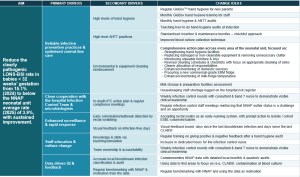
- Reliable infection prevention practices & optimised central-line care: We changed our practice to daily hand hygiene (HH) audits, with compliance results collated monthly. Compliance was at least 93% in every month throughout 2025, and the results were reviewed at the monthly infection control meeting. To seek external validation, we invited the Trust Infection Control Team to do periodic hand hygiene audits and provide feedback, and their results were similarly encouraging. Similarly, the department conducts regular ANTT audits (reviewing aseptic fluid and medicine preparation and administration). The monthly ANTT compliance was 100% across all months of 2025. Our trainees receive formal teaching to provide structured feedback for HH audits. We also strictly enforced central line insertion and maintenance checklists.
- Visual Management: We introduced a board tracking the “Number of days since the last CLABSI and true blood culture-positive LONS”, which was actively highlighted during every handover to maintain constant awareness.
- Enhanced Surveillance & Outbreak Control: We utilised weekly rectal swabbing of all babies to monitor extended-spectrum beta-lactamase (ESBL) colonisation, leading to rapid isolation strategies guided by the Microbiology team. We maintained a low threshold for initiating outbreak control measures. The microbiology department reviews all culture and antimicrobial susceptibility patterns, including those from weekly surveillance swabs, and, if needed, advises appropriate isolation strategies. We have a low threshold for initiating outbreak control measures (even stricter HH and ANTT measures).
- Multidisciplinary Collaboration with the hospital Infection Control Team & microbiologists: We instituted monthly infection-control meetings specifically with our microbiologists to review culture and antimicrobial susceptibility patterns.
- Detailed action plan: A multidisciplinary meeting with all stakeholders, which was preceded by the trust IPC team carrying out regular NICU visits to understand the NICU workflow and practices, generated a 111-item action plan covering every clinical area, almost all of which were closed by the time of writing. This ranged from practical fixes (replacing a faulty milk fridge with no working temperature alarm, removing wooden furniture, replacing damaged upholstery on parents’ recliner), to generalised decluttering, to a full equipment-cleaning inventory specifying the correct product, method, and frequency for every piece of reusable equipment on the unit. We also undertook periodic environmental sampling to identify and address potential infection-control risks.
- Staff education & culture change: We conducted regular (departmental lectures and capsule teaching) teaching sessions regarding bloodstream infection, CLABSI and hand hygiene practices. We also conduct sessions on the same topics during departmental induction. We also have posters focused on the same topics. We also conduct weekly infection control walks led by consultants and band 7 nurses to demonstrate visible clinical leadership.
- Data-driven QI & feedback: The department conducts its own audits of bloodstream-related infections, which discern between true BSI and contamination. This allows us to identify areas for focused CLABSI prevention.
Figure 1: Driver diagram: System-Wide Interventions to Reduce Late-Onset Bloodstream Infections in Infants <32 Weeks Gestation
Barriers to improvement:
Even with all the enthusiasm generated during this project, it can be quite difficult to sustain momentum and avoid alert fatigue during an outbreak response. While rectal swabbing proved highly useful, cohorting ESBL-colonised infants was challenging due to space constraints, especially for healthy, growing preterm babies who received barrier nursing.
Several other barriers were identified, but they were mitigated through active involvement of the IPC team and senior trust management. When the breast milk refrigerator was found to be faulty, it was removed from use and replaced. With the trust’s financial constraints, this needed approval from the trust’s senior management. Estates’ capacity constraints delayed some structural improvements, but interim risk-reduction solutions were actively sought, and the action-plan approach with clear job allocation ensured that unresolved issues were included in the prospective capital and estates plan. Staffing shortages, especially in housekeeping, were thought to be contributing to increasing outbreak risk, and the issue was escalated to the trust risk register.
Outcomes
The project has achieved significant success, reducing the NNAP bloodstream infection rate among babies born before 32 weeks from 15.1% in 2024 to 2.5% in 2025 (see figure 2). This is well below the 6.1% average for neonatal units like ours, and below the overall neonatal unit average proportion of 3.9%2. A comprehensive local audit of all NICU blood cultures showed true-positive blood cultures decreased from 27 in 2024 to 15 in 2025. ANTT compliance remained at 100%, and hand hygiene compliance ranged from 93% to 100% throughout the year.
Figure 2: Run chart comparing LWNC NICU monthly bloodstream infection (BSI) rate with the NNAP neonatal unit average.
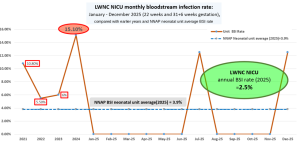
During 2025, we obtained 763 blood cultures, 36 of which were positive. Of these, 21 were classified as contaminants and 15 as true bacteraemia (5 early-onset, 10 late-onset). Among the 15 true bacteraemia cases, 6/15 were Category 1 and 9/15 were Category 2; 6/15 babies also met the surveillance definition for CLABSI. Although contaminants accounted for 58% of positive cultures, the overall contamination rate was 2.75% of all blood cultures sent, meeting our target of less than 3%. Among infants born before 32 weeks’ gestation, only two of the 81 NNAP-eligible babies had culture-confirmed late-onset bloodstream infections, giving a BSI rate of 2.5%, below the overall neonatal unit average proportion of 3.9%. Of the six CLABSI episodes, four were associated with PICC lines and two with umbilical venous catheters. For quality improvement purposes, episodes occurring within five days of line insertion were considered more likely to relate to insertion practice (4/6), while those occurring after five days were considered more likely to reflect line maintenance (2/6). This pragmatic approach helped focus our interventions on the stage of care most likely to have contributed to infection.
Our priority now is to sustain the improvements already achieved while further reducing CLABSI. We plan to continue regular teaching on hand hygiene and ANTT, maintain hand hygiene and blood culture audits, provide simulation training for central line insertion and maintenance, carry out regular competency assessments, and continue 3- to 6-monthly surveillance audits. We will also continue displaying the number of days since the last CLABSI or late-onset sepsis episode to reinforce awareness and maintain engagement across the multidisciplinary team.
[2 – As referenced on the NNAP RAD 03/09/2026]
Challenges and Learnings
While our overall bloodstream infection rates decreased drastically, CLABSI rates have remained a persistent challenge, accounting for a higher proportion of our truly positive blood cultures, with a significant proportion contributed by coagulase-negative staphylococci. Our key learning is that without continuous vigilance, we cannot sustain this level of success long term. We also attribute the implementation of the visual board, the detailed multidisciplinary action plan, and routine serial rectal swabs as primary drivers of our success. Another key learning is that sustained reduction in bloodstream infections requires a whole-system response, not a knee-jerk policy change or sporadic teaching sessions.
Our weekly rectal swabbing routine, first introduced after an ESBL E. coli outbreak, proved to be an invaluable tool. It allowed us to spot patterns early and respond before problems escalated into clinical sepsis. This turned surveillance into a proactive safeguard rather than a reactionary measure.
Top Tips For Implementation
- Continue to use a detailed organism-level audit in your NICU to differentiate between true infections and contamination, not only among babies less than 32 weeks but also among any other babies who are admitted to the unit.
- Hand hygiene, ANTT, and cleaning and disinfection practices, central line (both insertion and maintenance), routine surveillance, and periodic environmental sampling should be combined rather than being used as a single intervention.
- Use handovers, display boards, and regular feedback to make IPC-related results visible.
- Structured feedback during hand hygiene is essential to improve hand hygiene culture.
- Based on the routine rectal surveillance, escalate early when the surveillance suggests epidemiological spread, even before a major clinical outbreak happens.
- Involve the wider microbiology, trust infection control team, domestic services, estates, and family opinion, as their input is invaluable and in no way less important than the immediate bedside team.
- This bundle approach can be adopted by other similar hospitals to reduce infections.
Acknowledgements
We acknowledge the contributions of the NICU nursing and medical teams, the Trust IPC team, microbiology consultant colleagues (especially Dr Monika Pasztor), domestic services, and estates for their sustained work in reducing bloodstream infections and improving neonatal patient safety.