
Improving the delivery of breastmilk in the first two days of life
This 2026 quality improvement project aimed to improve breastmilk initiation rates within a teaching hospital neonatal unit
Authors
R. Murphy, J. Chean, D. King Williams, A. Owens, Mrs R. Agass, Dr R. Garr. Perinatal Team, Whiston hospital, Mersey & West Lancashire Teaching Hospitals NHS Trust.
Background
Our neonatal unit at Whiston Hospital was identified as a National Neonatal Audit Programme (NNAP) “alarm” level outlier for their Breastmilk Feeding at Day Two measure. Our results in 2024 were 38.7% for this measure, compared to a national average of 66.8%. The following causes were identified:
- Poor input of data on the BadgerNet database.
- Staff knowledge regarding giving the colostrum as soon as available to the baby
- Parents choosing not to breastfeed/give breastmilk.
Our team embarked on a quality improvement project to improve breastmilk initiation rates within our unit. Our key stakeholders were parents, neonatal nurses, midwives, resident doctors, neonatal paediatricians and obstetricians.
Measures
Success of this project would be measured by monthly review of BadgerNet data, and through PDSA (Plan, Do, Study and Act) cycles.
Improvement Plan
- The NNAP breastmilk feeding on day two outlier notification was shared in many fora including perinatal meeting, patient safety meeting, paediatric meetings and with the executives.
- A senior nurse had dedicated time to investigate the data.
- Staff training was started to support data input, care plans, pump use and hand expressing.
- Breastmilk expressing care plans (network care plan) were introduced for all babies.
- Colostrum packs to be given to expectant mothers at counselling, as well as information on breastfeeding and expressing breastmilk were also introduced.
- Doctors were reminded at several handover sessions to take a ‘breastfeeding’ pack when going to counsel expectant parents.
- Teaching sessions on neonatal optimisation highlighted the importance of maternal breastmilk being included in the medical management plan, particularly emphasising that breastmilk should be given to the baby as soon as it was obtained.
The following barriers were faced during this project:
- Time constraints of the neonatal team to discuss breastfeeding with parents while on their shift. We worked to mitigate this by proving written information to parents to reinforce verbal information provided on breastfeeding.
- Dedicated time for the nurse breastfeeding lead to carry out their role: This was averted by contributing extra hours to provide infant feeding training to staff.
Outcomes
As a result of this project, our rates for the NNAP Breastmilk feeding on day two measure increased from 38.7% in 2024, to 81.1% in 2025.
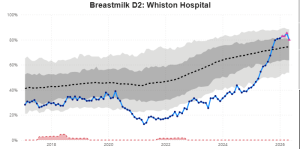
Figure One: Trend of percentage of breast-feeding infants less than 34 weeks in the first two days of life over the last 10 years.
As a result of this project:
- More feeding support has been provided to parents, initiating discussions on feeding choices and benefits of breastmilk.
- Embedded practice of breastfeeding packs being supplied when counselling parents.
- Improved care and empowered parents.
Improving staff confidence for feeding support and at giving colostrum as soon as it is obtained. - It is hoped this will increase the number of mothers who subsequently breastfeed their infants at discharge.
Our improvement will be sustained by:
- Ideally protected dedicated infant feeding hours and role.
- Staff continue to accurately input breastfeeding data onto BadgerNet, and the data nurse will ensure completeness. Continued staff training and updates to ensure early support and that colostrum pack is given and used at the earliest opportunity.
- New staff are taught about the importance of early breastmilk as part of preterm optimisation and for subsequent sustained breastfeeding at their induction and/or at regular grand rounds.
- Breastfeeding packs to be given to mothers at counselling for a preterm birth.
The following feedback has been provided by parents:
“This is the most I’ve learnt about infant feeding in one session.”
“Rachael is very knowledgeable, passionate, engaging with breastfeeding and always willing to help staff and families alike.”
Challenges and Learnings
During this project, we found it challenging to have dedicated time for nurses to educate parents on breastfeeding sufficiently. We supported neonatal nursing staff by utilising network breastfeeding groups and educators.
Top Tips For Implementation
- Have someone with dedicated time to ensure data completeness on the BadgerNet database.
- Involve the whole perinatal team.
- Get doctors involved to ensure breast milk is included in the daily management plan.
- Breastfeeding packs should be made available so they can be taken along during perinatal counselling.
- Strive for the UNICEF Baby Friendly Initiative accreditation, which involves funded training and dedicated infant feeding nurse role.
Acknowledgements
The whole perinatal team for their support in ensuring optimisation of the care of the newborn and parents for feedback.