
Using Game Theory to drive improvement: The Normothermia Grand Prix!
This 2026 quality improvement project aimed to improve normothermia in preterm infants using game theory
Authors
- Dr Rupjani Banerjee, Consultant Neonatologist, RCPCH College Tutor & Neonatal Data Lead
- Dr Donna Winderbank-Scott, Consultant Neonatologist, Neonatal QI Lead & Clinical Lead
Neonatal Intensive Care Unit, Princess Anne Hospital, University Hospital Southampton NHS Foundation Trust
Background
The National Neonatal Audit Programme (NNAP) report for 2024 data identified our neonatal unit as “an outlier at alarm level” for achieving normothermia in babies born at less than 34 weeks. We were achieving 64.2% compliance compared to 77.6% nationally; and it was especially disappointing as previously we had been positive outliers for this audit measure.
Causes of the problem:
We had already recognised the issue during our routine surveillance of preterm optimisation measures using the NNAP Restricted Access Dashboard (RAD) and local data analysis. Awareness had been raised in various meetings; and underlying causes were investigated with a Deep Dive analysis of the data.
Figure 1: Scatter plot to show distribution of temperature ranges achieved based on gestational age at birth (top) and birthweight (below) for a 1 year period (January – December 2024) for all inborn babies less than 34 weeks gestation who survived to admission.
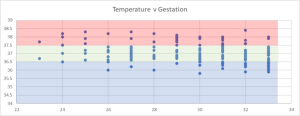
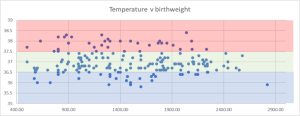
We found that smaller gestation babies were being over-heated (due to teams concentrating on avoiding hypothermia in this population), whilst more mature babies, especially those of low birthweight were still being admitted cold. There was no seasonal variation in our data. An important factor was a focus on airway management and intubation / surfactant administration, rather than on thermoregulation during birth. A further issue was that some babies were admitted with a normothermic temperature but didn’t fulfil the measure because they were greater than one hour of age at the time of admission to the neonatal unit. This was exacerbated by prior improvement work to give extended cuddles and time for the family to be together after birth.
Project aim:
The main aim was to improve normothermia in preterm infants when traditional methods of education, raising awareness, and standardisation of processes have already failed to achieve results.
Stakeholders:
The neonatal team, maternity team and most importantly our babies and their families.
Measures
We used our performance in achieving normothermia as our primary outcome measure. This was derived from BadgerNet data on the NNAP RAD as well as within local spreadsheets. Keeping more detailed local data was essential to be able to analyse ranges (more consistent temperatures with a narrower range of variation is related to a more stable and better process) and to account for babies admitted >1 hour of age.
We also evaluated other aspects of the project including collecting feedback on education and simulation training, loosely based on the Kirkpatrick model.
Our improvement plan
A multipronged action plan was created with actions under the following domains:
- Raising Awareness: We highlighted our NNAP and deep dive analyses in Departmental and Trust level platforms including presenting on the World Patient Safety Day Meeting and with the wider Neonatal and Maternity networks via the Preterm Optimisation Community of Practice and SONeT (Neonatal Transport Service) CDRM. This enabled shared learning from other units in the network and to reinforce good practice.
- Education: We shifted the focus of educational activities from just keeping babies warm to avoiding hyperthermia as well as hypothermia. This was taught at induction for new staff, a dedicated simulation session was run every 6 months, and the topic was highlighted in Theme of The Week (TOTW) and the Neonatal Education Newsletter (NEST). We also developed more interactive ideas such as using the polling options within Whatsapp to create Quizzes on the resident doctor group.
- Environment: An audit was conducted of delivery suite and the theatre ambient temperatures to find out if this was contributing – we did not find this to be the case.
- Standardising Processes: We had previously introduced a clipboard and paper proforma to document stabilisation (as pictured), with prompts for key events e.g. time of intubation. This was amended with prompts to record temperature at various times (e.g. prior to and after Birthday Cuddles), and document action taken. This had some positive effect but was not always taken to deliveries (a clipboard could not always be found despite providing 10 of them in various locations). The proforma was also inconsistently completed.
- Engagement: this was the most challenging aspect to address. We developed an innovative idea to use Game Theory and elements of competition and peer pressure to increase motivation and effort amongst the teams attending deliveries. A racetrack background was created, based on a well-known computer game (see image below). Each clinician was encouraged to colour in their own character; these were laminated and attached to the racetrack in the starting position. Each preterm admission was a chance to move along the racetrack by achieving an admission temperature within the normal range. The entire team attending the delivery get to move, encouraging teamwork and shared responsibility for thermoregulation. Regular updates on who is leading in the race were shared on a group WhatsApp, and the winners after 6 months were presented with certificates.
Figure 2: Neonatal Clipboard Documentation Proforma
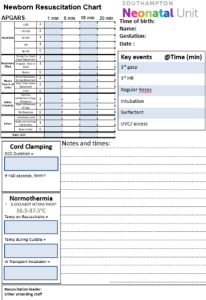
Figure 3: Photograph to show the race-track layout and personalised tokens representing each member of the neonatal team
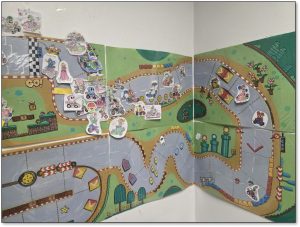
The race was met with a lot of enthusiasm and excitement amongst the neonatal team and raised the profile of normothermia significantly. Being able to advance your character along the track gives a boost and reward for the team, helping embed positive behaviours. We were amazed by the sudden, dramatic and sustained improvement in performance in normothermia as a result. This improvement continued throughout the entire 6-month period and performance did not wane over time as we had seen previously.
After 6 months, all the players returned to the start and the race recommenced with the next rotation of doctors entering the unit. We commenced a new PDSA cycle and made changes to the game designed to improve performance further – if the admission temperature is in the centre of the range, you can move 2 spaces instead of just 1, and temperature outside of the range means the character has to go back a space.
Barriers:
Several issues were encountered. For example, standardising the process using clipboards to document temperatures at set points during stabilisation failed when the clipboards couldn’t be located or had been re-purposed. We tried to overcome this by using bright pink clipboards instead of the original black ones – however these still ended up going missing.
The racetrack game had occasional issues with admissions not being entered on the list, (especially if the temperature was outside range and the characters should be moving backwards!) This was overcome by spot checks to ensure all admissions were on an accompanying paper sheet and we kept them to ensure characters were being moved appropriately and fairly. One (unfortunately unsolved) issue is that clinicians who work less than full time may have fewer opportunities to move down the racetrack, but we have been open and honest with the team that this is the case; and have not had any negative reaction from those affected.
Outcomes
Figure 4: Local data to show timing of main PDSA cycles and their effect on overall performance
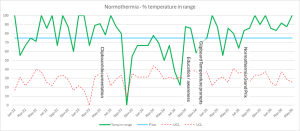
The NNAP data shows a consistent improvement in performance which is most marked in the greater than 28-week population. We are still not achieving greater than 80% on the RAD due to admissions over 1 hour age. This is why our local data looks slightly better as this does not take into account the time of admission.
Figure 5: Graph to show proportion of inborn babies less than 34 weeks gestation with an admission temperature within range taken within an hour of birth. Graphs taken from the NNAP Restricted Access Dashboard
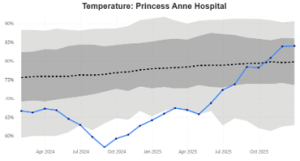
Figure 5: Graph to show proportion of inborn babies less than 34 weeks gestation with an admission temperature within range taken within an hour of birth. Graphs taken from the NNAP Restricted Access Dashboard

We are consistently achieving normothermia in over 85% babies since the onset of the Racetrack game in September 2025.
Sustaining the improvement
The success and sustainability of this project is dependent on maintaining engagement. We found that a fun, innovative and interactive activity such as a competitive game is much more effective than our previous change ideas in changing behaviours and performance in the longer term. We will continue to innovate and develop the game in 6 monthly PDSA cycles, (timed with the rotation of clinicians through the department) to maintain novelty and excitement amongst the non-rotational members of the neonatal team; and keep normothermia a visibly high priority for preterm infants.
Challenges and learnings
We learnt that sometimes a change of approach is required. You can add in extra forms, processes and checkpoints to try and make people behave in a certain way, or educational sessions to encourage them to understand why they should do something to motivate their behaviour; but this only works to a certain extent. Improvement above this requires buy-in, enthusiasm and continued effort from all involved. We have shown this can be deliberately engineered through the use of competition and game theory, by giving personal and group rewards for desired behaviours and encouraging extra effort to achieve a target – in this case, an admission temperature within range.
Oversight of the game and checking that admissions are being recorded is essential and characters are moving – having a champion or responsible person to spot-check at intervals became necessary; and intermittently “celebrating” whoever is in the lead helped renew enthusiasm. Consultant involvement also helped – resident doctors love to overtake their seniors!
Top tips for implementation
- Have a guideline / standardised approach and a target as a baseline.
- Educational sessions and posters help people know what to do and why to do it.
- Quizzes (e.g. on WhatsApp groups) raise awareness of the problem as well as educating.
- Simulation enables the team to practice and “learn from doing.”
- Checklists and prompts help the team behave in a certain way at critical points during a process – e.g. by writing down the temperature, they are reminded to take corrective action.
- Use a game and competition to motivate, build engagement and reward extra effort
- This can be low cost, hand-made or printed and laminated, and use resources already available e,g,”sticky-tac” to attach characters to the board
- The racetrack concept can be generalised to increase any behaviour or outcome measure in Quality Improvement.
- Innovation and novelty are extremely useful strategies to use in QI! Personalisation (e.g. colouring in characters) increases engagement further.
- Once an improvement is made, continuously monitor it.
- When performance starts to deteriorate, do something new e.g. a quiz, a celebration, or change the rules of the game.
Acknowledgements
Matt Davies, Data Manager, Maharmat Chavoshzadeh, Clinical Fellow and Trainee Data lead, Hannah Mallon, Neonatal Safety and Quality Assurance Matron, and the entire Neonatal Team who made this all possible.