
Golden Early Minutes (GEM), Improving Cord Management in Preterm Infants: A Multidisciplinary Quality Improvement Project.
This 2026 quality improvement project aimed to increase deferred cord clamping in eligible preterm deliveries
Authors
Macaskill L (Paediatric Registrar ST8), Shah K (Specialty Doctor), Thottungal M (ANNP), Booth Davies J (Periprem lead Midwife), Scott K (Saving babies lives lead Midwife), Dodds M (Midwife), Ramsay R (Paediatric Registrar ST5), Banerjee Oberoi S (Consultant Obstetrician), Jain P (Consultant Paediatrician and Neonatologist), Walsall Healthcare NHS Trust.
Background
Deferred cord clamping (DCC), defined as deferred umbilical cord clamping for at least 1 minute or resuscitation with an intact cord, improves outcomes in preterm infants, such as mortality, as evidenced in randomised controlled trials. National guidance from the British Association of Perinatal Medicine (BAPM) supports the use of DCC.
Review of local National Neonatal Audit Programme (NNAP) data demonstrated that only 47.9% of eligible preterm infants at Walsall Manor Hospital had DCC in 2024, identifying the unit as a national negative outlier. This highlighted a significant gap between evidence-based recommendations and local practice.
Initial review identified several contributing factors, including variation in staff knowledge and confidence, inconsistent team communication and role allocation, lack of standardisation of delivery room processes and practical barriers to providing support at the bedside with an intact cord.
The project’s aim was to increase DCC in eligible preterm deliveries from 47.9% to greater than 90% in the next 24 months, from January 2025 to December 2026.
Stakeholders identified included neonatal medical staff, advanced neonatal nurse practitioners, neonatal nurses, midwives, obstetricians, delivery suite staff, theatre teams, and the PERIPrem quad.
Measures
Improvement was measured using monthly DCC data collected through NNAP. The Data was then plotted on a run chart to assess changes over time and identify sustained improvement following interventions.
Improvement Plan
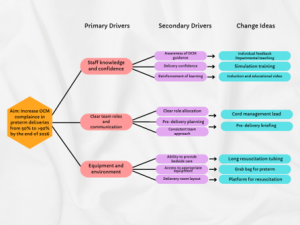
The project used the Model for Improvement methodology, supported by process mapping, fishbone analysis and a driver diagram to understand barriers and identify opportunities for change. The driver diagram was developed using findings from process mapping and fishbone analysis. Three primary drivers influencing DCC compliance were identified: staff knowledge and confidence, team roles and communication, and equipment and environment. Secondary drivers and associated change ideas informed the design of sequential PDSA cycles.
Figure 1. Driver diagram demonstrating the theory of change underpinning the quality improvement project
Barriers and How They Were Addressed
Sustaining behaviour changes were challenging, particularly when relying on individual feedback in a busy clinical environment. This was addressed by moving towards embedded educational approaches, including simulation, visual prompts and plans for induction-based learning.
Coordinating change across neonatal and obstetric teams required flexibility due to differing priorities and clinical pressures. Regular multidisciplinary engagement and shared ownership of the project were critical in overcoming these barriers.
Outcomes
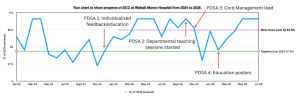
Compliance improved from a baseline of 47.9% in 2024 to a sustained 82.5% post interventions to date.
Run chart analysis demonstrated a sustained shift above baseline following implementation of interventions. The project successfully reduced variation in practice and improved adherence to national guidance.
Figure 2. Run chart demonstrating monthly compliance with optimal cord management in eligible preterm deliveries at Walsall Manor Hospital
The green line represents the NNAP 2024 baseline mean compliance of 47.9%, while the blue line demonstrates monthly OCM compliance from 2024 onwards. Annotated PDSA interventions include individual feedback and education, multidisciplinary teaching sessions, introduction of a cord management lead, and educational posters. Following implementation of these interventions, compliance demonstrated a sustained shift above baseline, improving to 82.5% post interventions; shown by the purple dotted line.
The project has strengthened awareness of the value of DCC across neonatal and obstetric teams and has established DCC as an important component of delivery room practice. The expected long-term impact is improved consistency of care and increased numbers of preterm infants benefiting from evidence-based cord management practices.
Improvement will be sustained through continued audit and PDSA cycles including the launch of the long T-piece tubing in delivery rooms, incorporation of education into staff induction, ongoing simulation training, use of educational resources and continued multidisciplinary ownership of the project. The long T-piece tubing is then planned to launch in theatre settings in collaboration with the theatre teams and ODP’s.
Challenges and Learnings
A key learning point was that education is a powerful driver of change but is not self-sustaining in isolation. Sustainable improvement required progression from individual-level interventions towards embedded system-level approaches.
The project also demonstrated the importance of multidisciplinary engagement and adaptability. Flexibility in timelines and interventions was required to accommodate real-world clinical pressures.
If repeated, earlier implementation of system-level interventions may have made sustaining improvement easier and even accelerated improvement.
Key factors contributing to our success included strong multidisciplinary collaboration, support from the PERIPrem programme and ongoing engagement with staff through feedback and education.
Top Tips For Implementation
- Start with a clear understanding of local barriers using QI tools such as process mapping and fishbone analysis.
- Engage both Neonatal and Obstetric teams from the outset.
- Use multiple interventions rather than relying on education alone.
- Combine behaviour-change strategies with system-level improvements.
- Monitor data regularly and share results with staff.
- Be prepared to adapt interventions in response to learning.
These interventions are low-cost and highly transferable and could be adapted by other neonatal units seeking to improve rates of DCC or other delivery room care practices.
Acknowledgements
We would like to thank the neonatal, obstetric and midwifery teams at Walsall Manor Hospital for their support and engagement throughout the project, together with the PERIPrem programme team for supporting data collection and improvement work.